
Currency Option Trading - How FX Options Work and When to Use Them
Published on March 2, 2026 | 6 min readReviewed by Leav Graves
Currency option trading can help you deal with currency moves without trading spot Forex directly. This article explains how foreign exchange options work, when foreign currency options make sense, and how US currency options are used. You will see pricing drivers, risks, and practical questions traders face before placing trades.
KEY TAKEAWAYS
- Currency option trading is a way to trade currencies using options, giving traders flexibility and limited downside risk compared to spot Forex.
- Foreign exchange options allow traders and companies to manage currency risk or express directional views without trading spot Forex directly.
- Premiums, volatility, expiration, and strike price are the main factors that influence pricing and outcomes.
What Is Currency Option Trading and How It Works
Currency option trading lets you take a position on currency moves using option contracts, so you can plan your risk upfront instead of being fully exposed like in spot Forex.
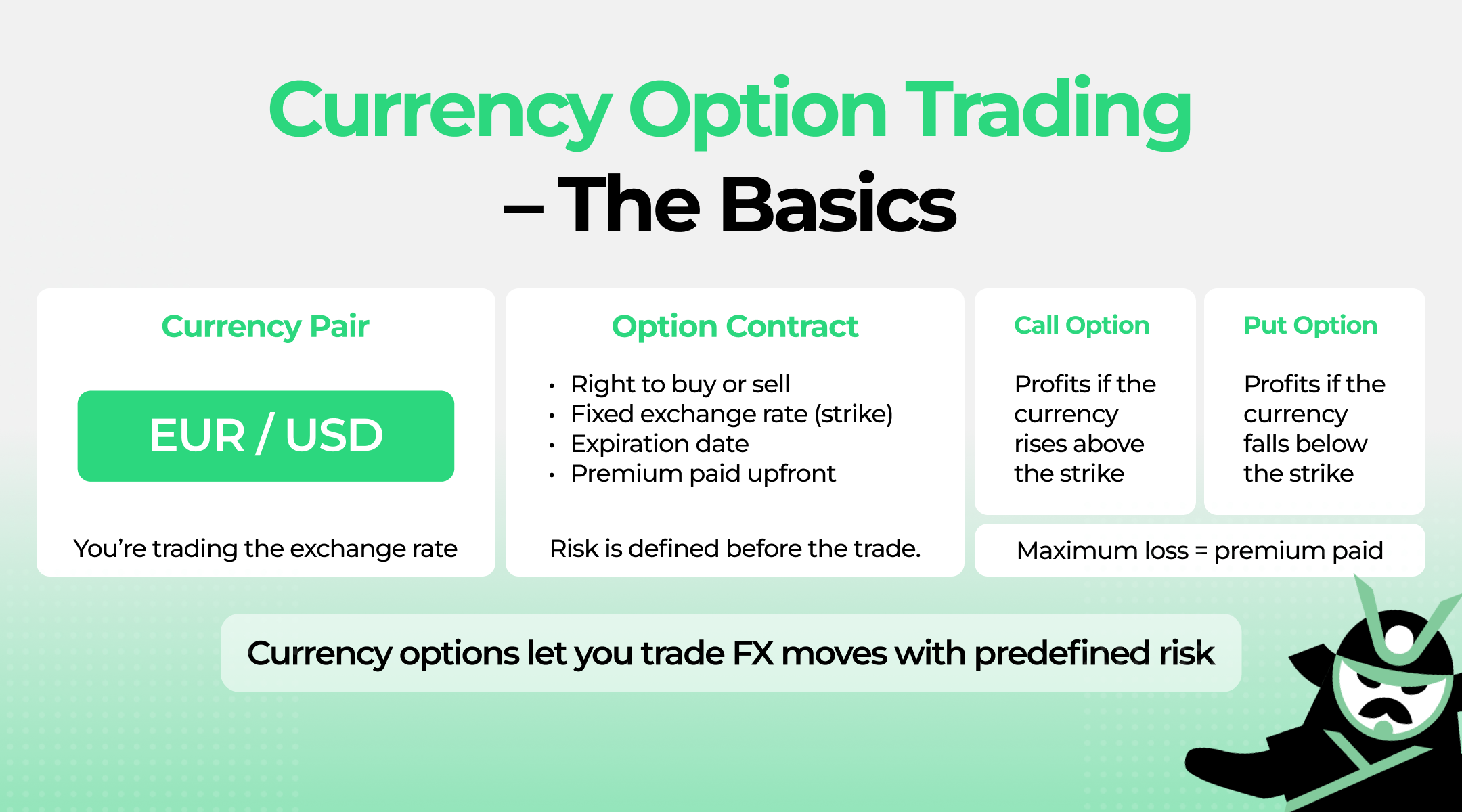
At its core, a currency option is an agreement between two sides. The buyer pays a premium for the right to buy or sell a currency pair at a fixed rate, called the strike price, before or at a set expiration date. The seller receives that premium and takes on the obligation to honor the contract if the buyer chooses to exercise it.
That right versus obligation is the key difference. The buyer can walk away if the trade does not work out, losing only the premium. The seller cannot walk away if the option is exercised.
A standard contract includes:
- A buyer and a seller
- A premium paid upfront
- A strike price that sets the exchange rate
- An expiration date that defines how long the option is valid
And here is a simple infographic to show the main traits of this contract:
Foreign exchange options are commonly used in two ways. Some traders use foreign currency options to hedge exposure, for example locking in a rate for future payments. Others use them for speculation, aiming to profit from expected moves in a currency pair with defined risk.
US currency options are often traded on regulated exchanges or through brokers, while foreign exchange options can also be quoted over the counter. In both cases, the structure stays the same, risk is known in advance, and outcomes depend on price, time, and volatility.
Why Is Foreign Currency Options so Popular in Forex Trading?
Foreign currency options are popular because they solve real problems for different types of market participants. A company that earns revenue in Euros but pays costs in US Dollars can use currency option trading to reduce the risk of sudden exchange rate moves. Large institutions use the same tools to manage exposure across many currencies, while individual traders use them to express a market view with defined risk.
One reason foreign exchange options work well in Forex markets is how currency pairs are structured. Each option is based on a pair, such as EUR/USD, where one currency is bought and the other is sold. The strike price sets the exchange rate for that pair, and contract size is standardized so traders know exactly what one option controls.
Common reasons traders use these contracts include:
- Hedging future cash flows or international payments
- Trading directional views without using spot Forex
- Limiting losses to the option premium
Liquidity also plays a role. Major pairs tied to US currency options tend to have tighter pricing and more active markets. In other regions, foreign currency options may trade over the counter, with much lower liquidity. Despite these differences, the core structure stays the same. Currency option trading remains popular because it offers flexibility, clear risk, and access to global currency markets without the need to trade spot directly.
Types of Foreign Exchange Options Available to Traders
Foreign currency options are popular because the basic building blocks are easy to understand and flexible in real trading. Most activity in currency option trading comes from vanilla options, meaning calls and puts (just like those you can find on our screener for US options on stocks and ETFs). A call option benefits when a currency pair moves higher than the strike price, while a put option benefits when it moves lower. In both cases, the buyer knows the maximum loss upfront, the premium paid.
The payoff profiles are simple:
- Calls profit from rising exchange rates above the strike
- Puts profit from falling exchange rates below the strike
- Losses for buyers are limited to the premium
Another reason foreign exchange options are widely used is how expiration works. Options can be American style, which allows exercise at any time before expiration, or European style, which only allows exercise at expiration. Most foreign currency options, including many US currency options (EUR/USD, USD/JPY, GBP/USD), are European style. This makes pricing cleaner and removes early exercise decisions for traders. This makes pricing cleaner through frameworks like the Black & Scholes option pricing model and removes early exercise decisions for traders.
Beyond vanilla setups, some non-retail traders look for more tailored outcomes. In those cases, exotic options can be used to shape payouts around specific price levels or scenarios. These are less common but useful in certain hedging or speculative situations.
Overall, foreign currency options stay popular because they combine clear payoff rules, flexible positioning, and expiration styles that fit how currency markets actually move.
US Currency Options and Market Specifics
US currency options sit at the center of global currency option trading because the US dollar is involved in most major currency pairs (which makes sense if you think about how global trade works). Contracts linked to pairs like EUR/USD, USD/JPY, GBP/USD, and USD/CAD attract consistent volume, which leads to tighter pricing and easier execution for traders.
These options are traded in two main ways. One is through regulated exchanges, where contract sizes, expirations, and settlement rules are standardized. The other is through over-the-counter markets, where banks and brokers quote foreign exchange options directly to clients. Both approaches are widely used, and each fits a different type of trader.
Exchange-traded US currency options appeal to traders who want transparency and consistent pricing. OTC foreign currency options offer more flexibility in strike selection, contract size, and expiration, which can be useful for tailored hedging.
Key differences between the two include:
- Exchanges use fixed contract terms and central clearing
- OTC markets allow custom strikes and expirations
- Pricing in OTC trades depends on the broker and market conditions
The US dollar plays a central role because it acts as the reference currency for global trade and capital flows. Whether traded on an exchange or quoted by a broker, US currency options give traders access to deep liquidity and familiar structures. This makes them a common entry point for traders exploring currency option trading and broader foreign exchange options.
Pricing, Premiums, and Risks in Currency Option Trading
Prices in currency option trading are driven by a small set of inputs that traders see every day on their platform. Most foreign exchange options are European style, so pricing is usually based on the Black and Scholes model. The model does not predict direction. It assigns a fair value using price, time, volatility, interest rates, and strike.
For foreign currency options and US currency options, this framework explains why option prices change even when spot rates do not.
Key drivers behind premiums include:
- Volatility expectations
- Time left until expiration
- Distance between price and strike
Because Black and Scholes assumes no early exercise, it fits currency markets well. Traders use it as a benchmark to judge risk, compare prices, and understand what they are paying for when trading currency option trading setups.
AUTHOR
 Gianluca LonginottiFinance Writer - Traders Education
Gianluca Longinotti is an experienced trader, advisor, and financial analyst with over a decade of professional experience in the banking sector, trading, and investment services.
REVIEWER
 Leav GravesCEO
Leav Graves is the founder and CEO of Option Samurai and a licensed investment professional with over 19 years of trading experience, including working professionally through the 2008 financial crisis.