
Risk Reversal in Options - How to Trade Direction With Minimal Upfront Cost
Published on December 29, 2025 | 7 min read(Last updated on February 20, 2026)
Reviewed by Leav Graves
Risk reversal options appeal to traders who want directional exposure without paying high option premiums. This article looks at how a risk reversal options strategy works, when a long risk reversal or a short risk reversal makes sense, and what each risk reversal option can offer during market turning points.
KEY TAKEAWAYS
- Risk reversal options setups are directional trades built by selling one out of the money option and buying another out of the money option, typically for low debit or credit. They can express bullish or bearish views, and they work well on assets at turning points.
- Traders use a risk reversal option to gain directional exposure with limited upfront cost, replacing expensive calls or puts with a more efficient structure.
- These strategies can give upside or downside potential depending on the configuration, making them useful for trend reversals, oversold or overbought setups, and volatility driven situations.
Understanding risk reversal options
Risk reversal options start from a simple idea: sell one out of the money option and buy another out of the money option to get directional exposure at a low cost. This setup can point bullish or bearish, and many traders use it when a chart looks ready to turn.
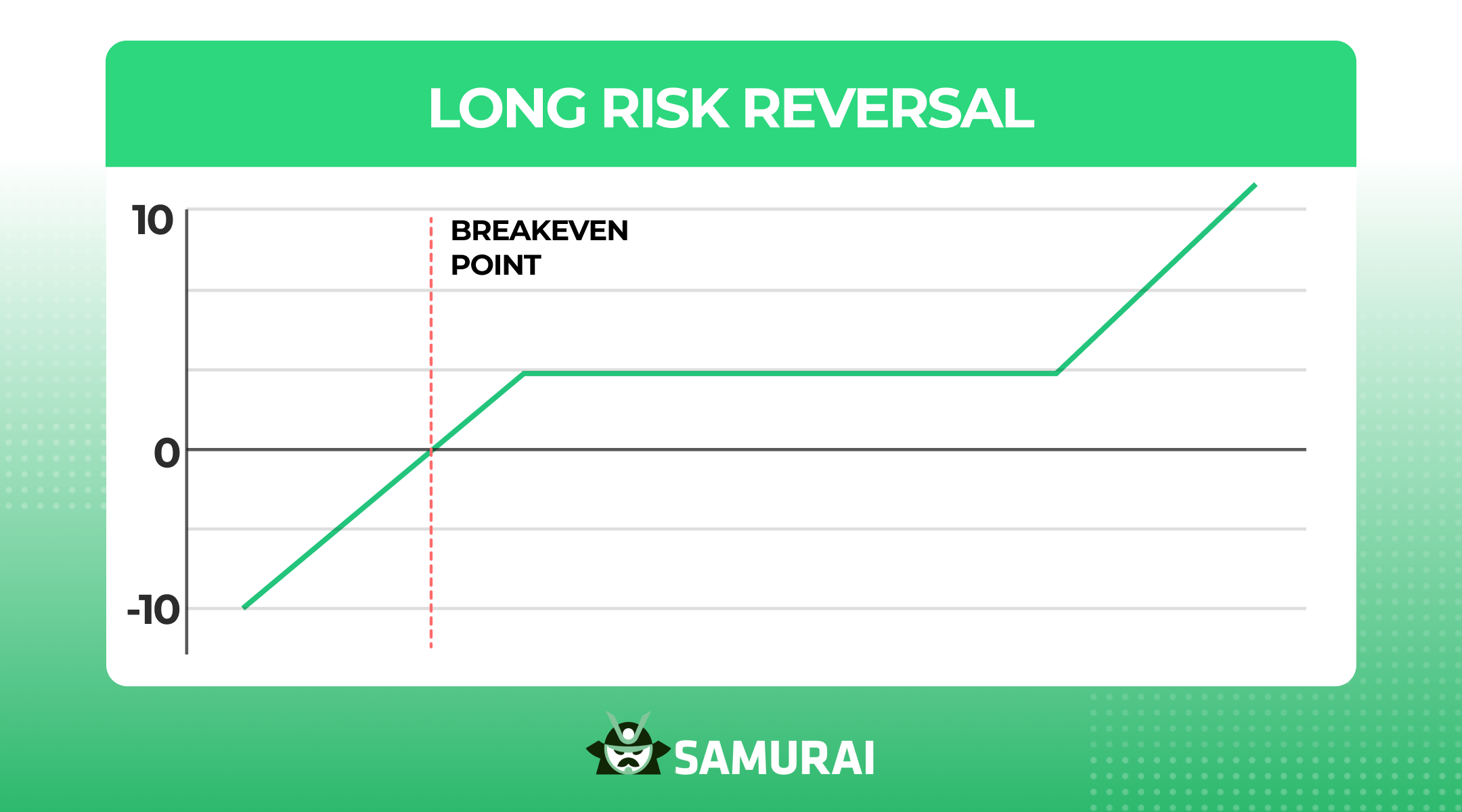
- A long risk reversal uses a short put and a long call.
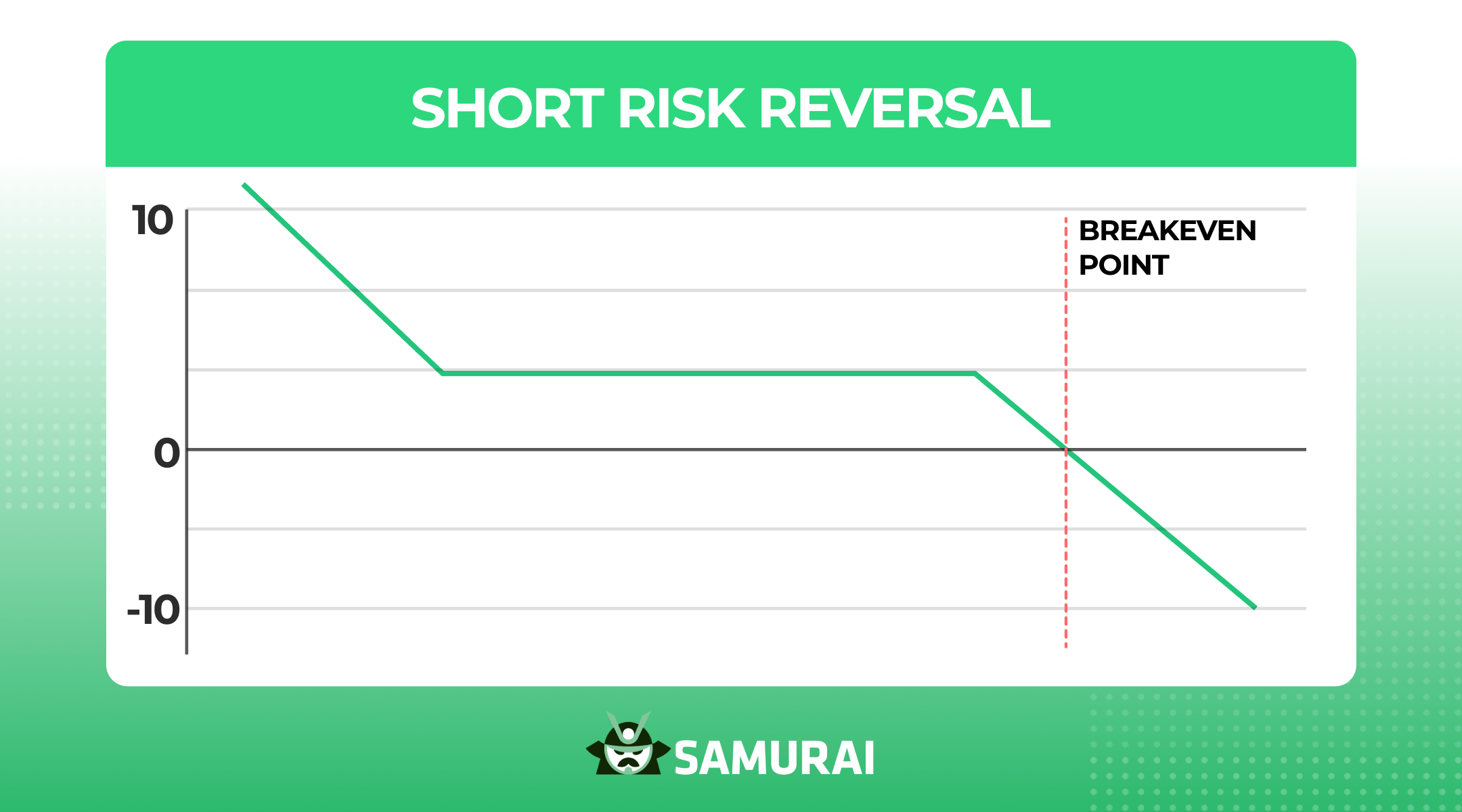
- A short risk reversal uses a short call and a long put.
Here is the profit and loss (P&L) chart of a long risk reversal
And here is the P&L of a short risk reversal:
Why Do Traders Rely on the Risk Reversal Strategy?
Traders rely on risk reversal options because they offer directional exposure without paying the full price of a single call or put. By selling one out of the money option and buying another, the structure often comes with a low debit or a small credit, yet it still keeps uncapped directional potential. The tradeoff is clear: the risk is also unlimited if the move goes the wrong way.
Why this setup appeals to many traders:
- It is cheaper than buying options outright.
- Volatility skew can make the long risk reversal or short risk reversal more efficient than stock or standalone options.
- A risk reversal option responds well when a market reaches an oversold or overbought point.
This balance of cost efficiency, directional exposure, and sensitivity to reversals is the main reason a risk reversal options strategy is so widely used.
How the risk reversal options strategy works
A risk reversal options strategy works by pairing one short option with one long option, and the net premium tells you whether the trade starts as a debit or a credit. If the option you sell is worth more than the one you buy, the structure brings in a credit. If the long leg costs more, you pay a small debit. This debit-or-credit behavior is exactly why traders often compare risk reversals with a debit spread vs credit spread framework, since both approaches hinge on how premium flow and probability interact.
The risk reverse setup creates directional delta right away. The short option gives you the initial push in one direction, and the long option keeps the trade open if the move continues.
Breakeven levels are simple. They sit just beyond the short strike for a long risk reversal, and just beyond the long strike for a short risk reversal.
Key points to keep in mind:
- The P&L increases in a linear way once price moves past the long leg.
- Assignment risk is always possible on the short side, so traders should plan for it. One specific scenario to be aware of is pin risk, which occurs when the underlying price settles right at your short strike at expiration, leaving you uncertain about whether assignment will happen. So, just to give you an example, you may choose to sell another option and find yourself with a risk reversal position combined with 100 shares.
How to trade a risk reversal
Trading risk reversal options starts with choosing the direction you want to express and matching it with the right pair of strikes. Here’s a table that sums up the structure of the main 2 versions of this strategy (which are both available on our options screener):
Setup | What you sell | What you buy | View |
Long risk reversal | Put | Call | Bullish |
Short risk reversal | Call | Put | Bearish |
Long Risk Reversal Options Strategy
A long risk reversal sells a lower strike put and buys a higher strike call. Traders often use this when a stock looks washed out, sits near support, or still shows solid fundamentals. The goal is to capture a rebound without paying full premium for a call.
Strike selection usually starts with delta. For instance, while this is not a rule, you may choose to look for a short put around delta -20 and a long call around delta 25 to 40.
Also, keep in mind that support levels help confirm where assignment would feel acceptable. Volatility matters as well: if puts are expensive, selling one helps reduce or remove the trade’s cost. The main risks are assignment on the short put, a deeper selloff, or entering too early before momentum actually turns.
Short Risk Reversal Options Strategy
A short risk reversal sells a higher strike call and buys a lower strike put. This works best when a stock looks stretched, stalls near resistance, or loses momentum. Traders often build it when calls trade rich compared to puts, since volatility skew improves the credit.
Strike choice again starts with delta. Just to give you an example: you may opt for a short call around delta 20 to 30 and combine it with a long put slightly closer to the money, which will react well to a pullback.
Once again, the main risks to know include early assignment on the short call, sudden upside spikes, and low liquidity on the put side if the move accelerates.
Examples of risk reversal strategies
Examples make risk reversal options much easier to understand. Once you see how the payoff reacts to price, the logic behind each setup becomes clearer.
To keep things practical, let’s look at two simple trades on AAPL, currently trading at 266.25 dollars. Both use the same expiration, both use the same strikes, and both show how flipping the legs changes everything in a risk reversal options strategy.
Long risk reversal options strategy example
A long risk reversal may consist of selling the 235 put and buying the 280 call, both expiring in six weeks:
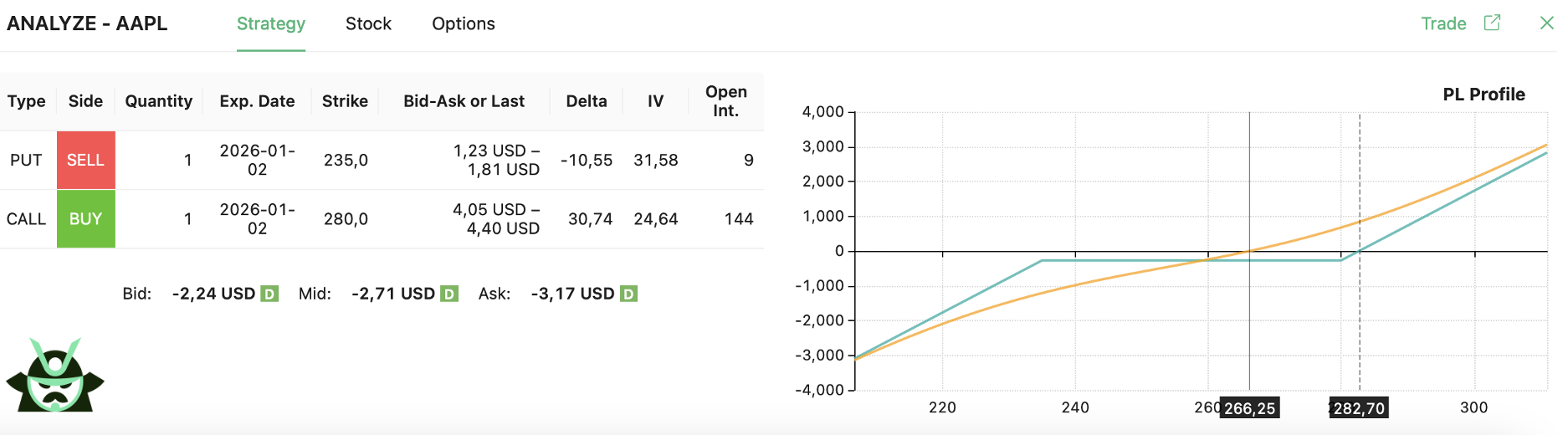
This version starts as a debit. You can see it right away on the P&L chart because the flat section sits below zero, at -270.50 dollars. The structure gives you unlimited upside if AAPL rallies, since the long call has no cap. On the downside, losses are also uncapped once price falls through the short put strike.
Why would anyone choose that? The main appeal is cost. Instead of paying full price for a call, you bring down the expense by selling the put. You still get exposure to a move higher, but you pay much less than buying a call outright. For a trader who believes AAPL is oversold, still has strong fundamentals, or is sitting near a well tested support zone, this setup can feel reasonable.
Short risk reversal options strategy example
Now look at the same strikes but flipped: buy the 235 put and sell the 280 call:
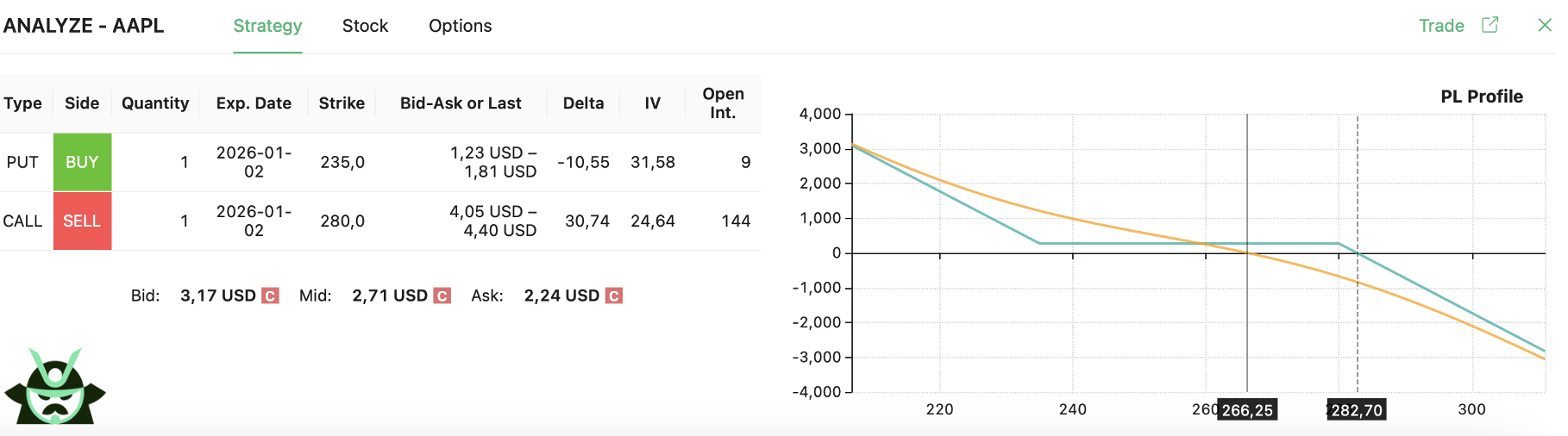
This creates a short risk reversal. It starts as a credit, which is visible on the P&L chart because the flat section sits above zero, at +270.50 dollars. Once again, both sides are uncapped. If AAPL collapses, the long put explodes in value. If AAPL takes off above the short call, losses stack quickly.
This version makes sense when a stock looks overbought or heavy near resistance. You are betting on weakness or at least a slowdown in the trend. Your goal is simple: avoid a breakout above your breakeven, which here sits near 282.70 by expiration. One reason some traders prefer this type of risk reversal option is the early credit. They like starting with a buffer instead of a debit. Volatility skew can also help. If calls are overpriced relative to puts, the credit grows and the structure becomes more appealing.
Variations of the risk reversal option
Risk reversal options are flexible, and many traders build variations to match their view. One simple change is using ratios. Going back to our AAPL examples, instead of a standard long risk reversal, you could sell two 235 puts and buy one 280 call.

As you can see, the P&L shows a much smaller debit, but the downside grows faster.
You can also turn a risk reversal option into a four leg structure. For instance, buy a 230 put, sell a 245 put, buy a 295 call, and sell a 305 call:
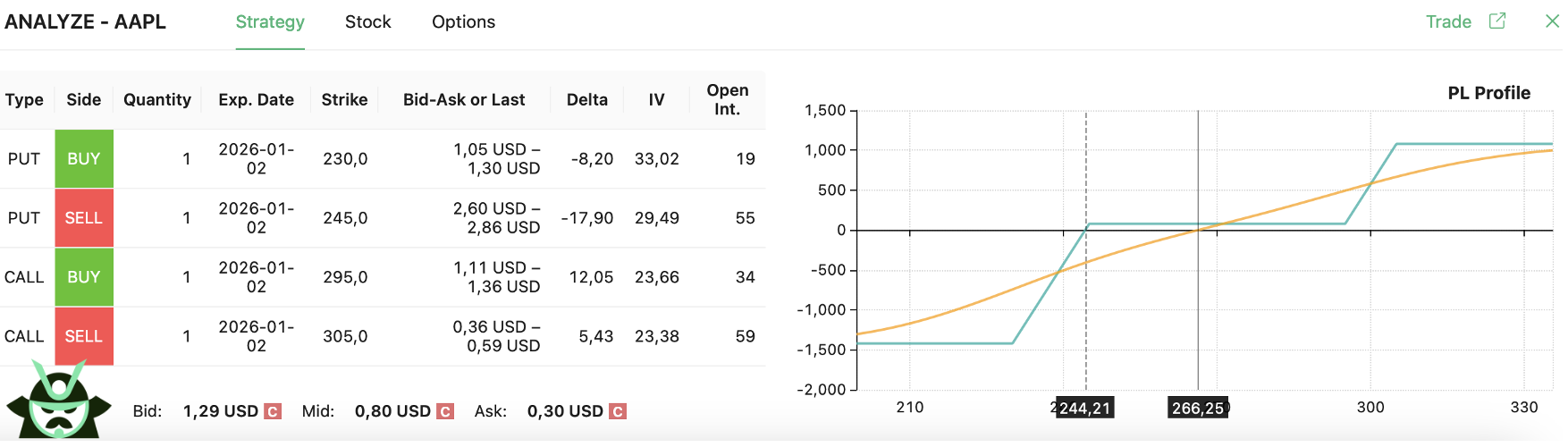
As you can see, the setup removed uncapped risk and caps profit, while still keeping the trade as a credit. You can try these and more creative versions of the strategy with our custom strategy screener feature.
And if you like this risk-averse version of the setup, perhaps you will like even more to read about a no loss option strategy, which is something you can scan for on Samurai.
AUTHOR
 Gianluca LonginottiFinance Writer - Traders Education
Gianluca Longinotti is an experienced trader, advisor, and financial analyst with over a decade of professional experience in the banking sector, trading, and investment services.
REVIEWER
 Leav GravesCEO
Leav Graves is the founder and CEO of Option Samurai and a licensed investment professional with over 19 years of trading experience, including working professionally through the 2008 financial crisis.