
Fiduciary Call - A Clear Explanation for Options Investors
Published on April 13, 2026 | 6 min readReviewed by Leav Graves
A fiduciary call combines a call option with capital set aside to cover the strike price. The main goal is to reduce uncertainty around exercise, as we allocated the cash needed to buy the asset. What is a fiduciary call? How does it work in practice? And why does the fiduciary call formula matter? Let’s find that out.
KEY TAKEAWAYS
- A fiduciary call is a strategy where a trader buys a call option and invests the present value of the strike price in a risk-free asset.
- By setting aside the strike in advance, a fiduciary call can reduce the effective cost and risk of exercising the option, as the trader has sufficient cash available to cover the assignment.
- Because the strategy relies on pre-funded capital, traders must ensure the risk-free investment matches the option’s expiration and remains available for exercise.
What Is a Fiduciary Call?
A fiduciary call is an options strategy where a trader buys a call option and holds the strike price in an interest-bearing, risk-free asset. The goal is to reduce uncertainty and costs associated with option exercise while maintaining the ability to buy the stock at a fixed price.
The word fiduciary often causes confusion. It does not refer to legal duties or account types. It simply means the money needed to exercise the option is reserved ahead of time. Once you understand what a fiduciary call is, this part becomes very intuitive.
So, what is a fiduciary call in practical terms? Instead of buying a stock and a protective put, the trader buys a call and invests the present value of the strike in a risk-free instrument, such as Treasury bills. Like a trustee, the trader already has the money needed to buy the stock at the strike price, which gives better control over risk. The position is designed to control risk (through the bond) while keeping upside exposure (through the call). If the stock rises, the call captures the upside. If it does not, the interest earned on the reserved capital helps cover part of the call loss.
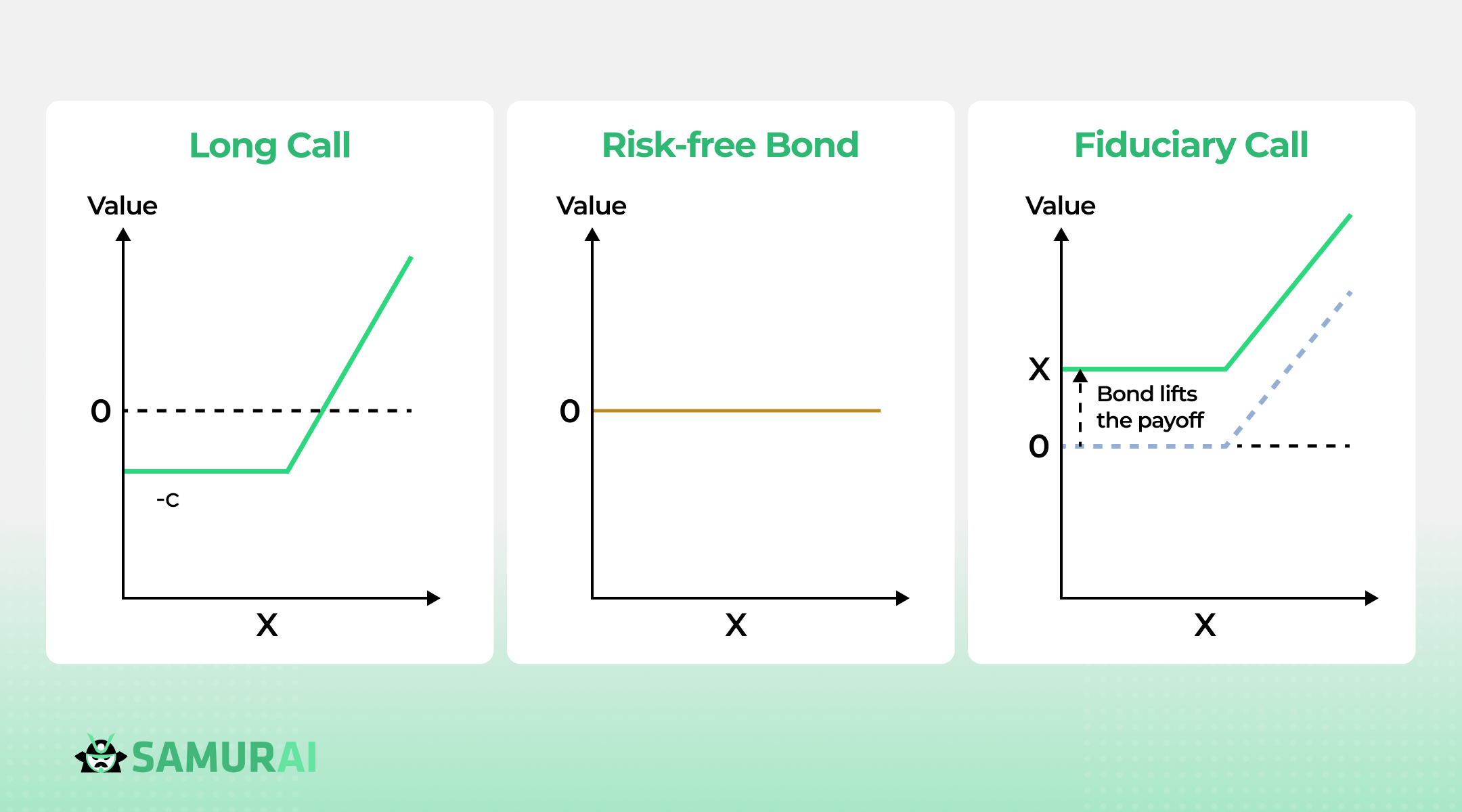
As you can see above, a fiduciary call has two clear components:
- A long call option on the underlying asset (such as one you may find on our screener for options traders)
- A risk-free investment sized so it grows to the strike price at expiration
This setup matters because it connects directly to put call parity. The fiduciary call formula shows that a call plus a bond can replicate the payoff of owning the stock and buying a put. That link explains why traders and analysts use this structure when studying synthetic positions and pricing relationships.
Understanding the fiduciary call formula helps traders see how different option positions can lead to the same result, even when they look very different at first glance.
Why Do Options Traders Use Fiduciary Calls?
The reason why options traders use a fiduciary call is that it pairs a call with capital reserved in advance, so the exercise price is already funded. This setup does not reduce the call’s downside, but improves funding and offsets part of the cost. That is the core fiduciary call meaning from an economic point of view.
For most traders, the value of a fiduciary call is not execution but understanding. The structure is mainly theoretical, but it plays a key role in pricing and hedging. The fiduciary call formula makes it clear that a call plus a bond can lead to the same payoff shape as other vanilla options positions. Think about it this way: you are simply “lifting” the long call P&L chart by a fixed amount “r”, which is your risk-free interest rate.
This view helps traders see equivalence across strategies, such as:
- A fiduciary call and a protective put sharing the same payoff
- Options and bonds combining to replicate stock exposure
- Different positions producing the same risk and return profile
That perspective makes it easier to evaluate trades, spot pricing issues, and think in terms of risk instead of labels.
How a Fiduciary Call Works in Practice
Execution starts with two actions taken at the same time. The trader buys a call option and sets aside cash equal to the present value of the strike price. That cash is invested in a risk free asset so it grows to the strike by expiration. This setup is what turns a simple call into a fiduciary call.
A quick way to see the structure is in the table below.
Step | Position | Purpose |
1 | Buy a call option | Keep upside exposure |
2 | Invest the present value of the strike | Fund future exercise |
3 | Hold until expiration | Let the structure play out |
From there, outcomes are very clear. If the stock moves above the strike, you can exercise the call. The bond has grown to the strike amount, so the shares can be purchased without adding new capital. The profit comes from the stock price minus the strike and the call premium. This is where the upside participation shows up.
If the stock finishes below the strike, the call expires worthless. The trader keeps the bond payout, which limits the loss. That is the downside protection part of the fiduciary call meaning.
Interest rates matter because they change the cost of the bond component, a relationship also visible in the Black & Scholes option pricing model. As you can imagine, when interest rates are near 0% the whole convenience of the strategy declines. Higher rates lower the present value of the strike, making the setup cheaper. Lower rates do the opposite. This link is visible in the fiduciary call formula.
This structure assumes the trader has cash to allocate upfront. That is why most people study what a fiduciary call is to understand pricing and risk, not because they plan to trade it every day.
Fiduciary Call Example with Numbers
Assume a stock is trading at $100 and a trader wants upside exposure for the next three months. Instead of buying the stock, they build a fiduciary call using a 3-month option and a US Treasury investment.
The setup could look like this:
Item | Value |
Stock price | $100 |
Call strike | $100 |
Call premium | $3.00 |
Time to expiration | 3 months |
3 month Treasury yield | 3.6% annual |
Bond price today | about $99.10 |
The trader buys the call for $3.00 and invests $99.10 in a risk free asset that will grow to $100 at expiration. This is the practical side of the fiduciary call formula.
If the stock rises to $110 at expiration, the call is exercised. The bond has grown to $100, which pays for the shares. The position is now worth $110. The total cost was $102.10, so the profit is $7.90. The upside behaves just like owning the stock above the strike.
If the stock stays at $100 or falls below it, the call expires worthless. The trader keeps the bond payout of $100 and loses the call premium. This limited loss is the core fiduciary call meaning.
Risks and Limitations of the Fiduciary Call
A fiduciary call trades safety for capital efficiency. The main cost comes from funding the bond upfront, which creates an opportunity cost compared to using that cash elsewhere. This is why the fiduciary call meaning matters more for analysis than execution. The structure also works best with European options, since American exercise makes timing uncertain. Interest rates matter too, because they change the bond cost inside the fiduciary call formula. And like any long call, the premium can still be lost.
Key limitations to keep in mind:
- Cash is tied up until expiration
- Less practical with American options
- Sensitive to interest rate changes
- Call premium can go to zero
Understanding what a fiduciary call is helps traders weigh safety against flexibility.
AUTHOR
 Gianluca LonginottiFinance Writer - Traders Education
Gianluca Longinotti is an experienced trader, advisor, and financial analyst with over a decade of professional experience in the banking sector, trading, and investment services.
REVIEWER
 Leav GravesCEO
Leav Graves is the founder and CEO of Option Samurai and a licensed investment professional with over 19 years of trading experience, including working professionally through the 2008 financial crisis.