Financial terms are often made to seem more complicated than they really are. An options contract is one of these terms that often intimidates newer investors. But you don't need a finance degree to get it. If you’ve ever used a coupon at the grocery store, you already understand how it works.
KEY TAKEAWAYS
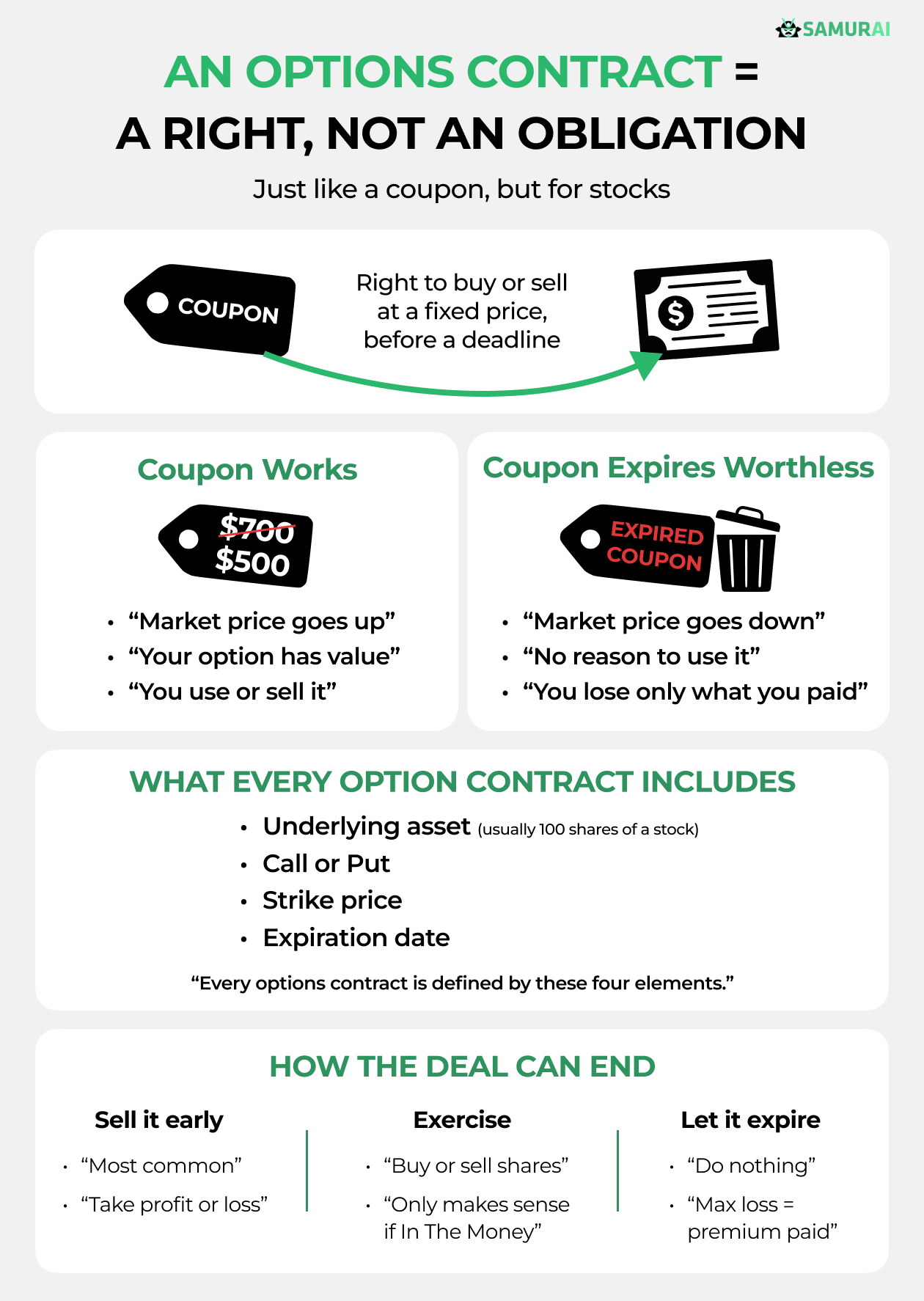
An options contract is a financial agreement that gives you the right (but not the obligation) to buy or sell an asset at a set price by a certain date.
An option contract is a financial derivative that derives its value from an underlying asset (like a stock).
They let you express a view on the future movement of the stock without owning it.
You use them to hedge risk or speculate on price movement.
What Is an Options Contract?
What is an options contract? Technically, it is a financial derivative that “derives” its value from an underlying asset (like a stock) and involves a specific agreement between two parties.
At its core, this contract is a tool for transferring risk. Originally, options were used by farmers to lock in prices for their crops ahead of time, essentially a form of insurance. Today, traders generally use options for two main reasons:
Protection (Hedging): Just like buying car insurance, you can buy contracts to protect your stock portfolio from a market crash.
Speculation (Leverage): This is the most common use for retail traders. It allows you to express a view on a stock's movement with a small amount of capital, aiming for a much larger return than buying the stock directly.
Regardless of your goal, every standard contract covers four main things:
The Asset: Usually 100 shares of a specific stock (like Apple or Tesla).
The option type: Either a Call (right to buy) or a Put (right to sell).
The Strike Price: The price at which you can either buy or sell the stock in the future
The Expiration Date: The deadline when the contract ends.
It is important to remember that this options agreement is a two-way street. If you are the buyer, you have the right to exercise the option and take ownership of the underlying asset. If you are the seller, you have the obligation to fulfill the deal if the buyer exercises their right.
We created a quick infographic to help you better understand everything we discuss in today's article:
The "Coupon" Analogy
The easiest way to understand this is to think of a store coupon. Imagine you pay $10 for a coupon (a call option) that lets you buy a 4K TV for $500. This coupon has an expiration date of 30 days, meaning that you can exercise your right to buy the TV anytime within 30 days.
Scenario A: The store price for the TV increases to $700. Your coupon now has intrinsic value because it lets you buy that $700 TV for only $500. You made a great deal.
Scenario B: The store price drops to $400. Why would you use your coupon to pay $500? You wouldn't, so you throw the coupon in the trash as it expires worthless.
In this scenario, the coupon is acall option contract. The most you could lose was the $10 you paid for it.
Option Contract Example
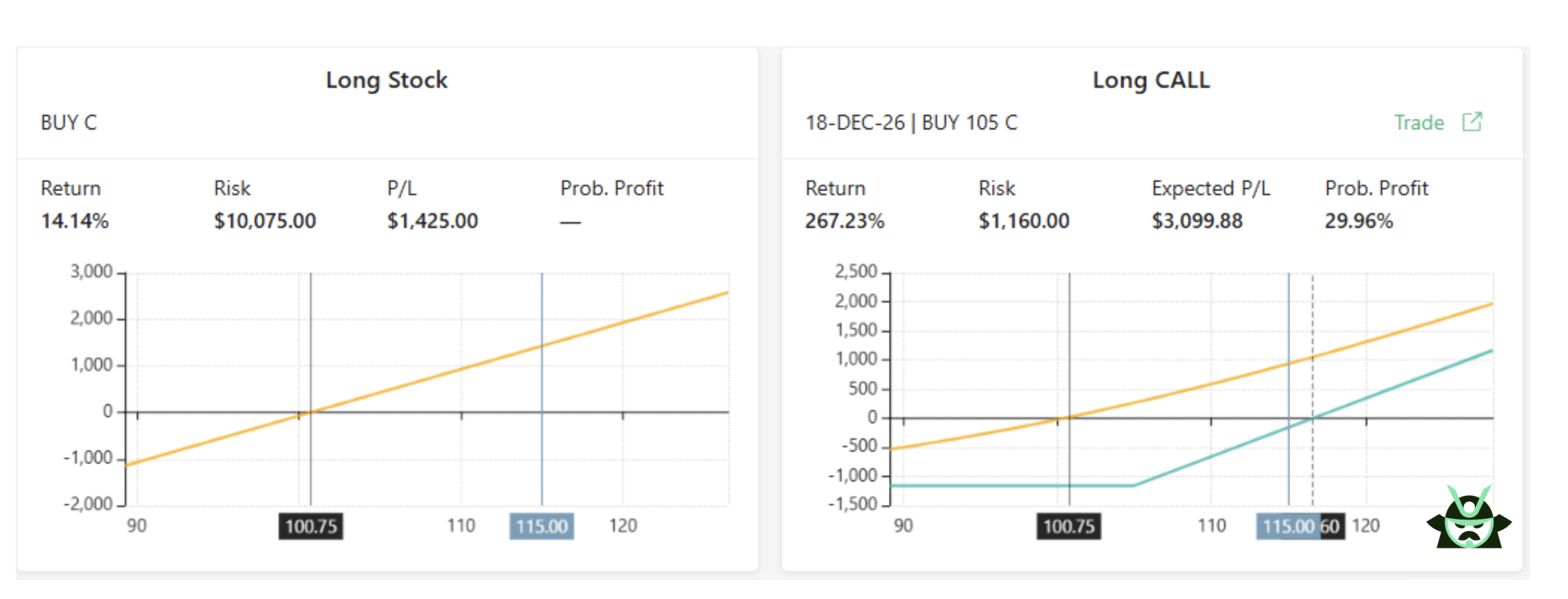
To fully understand this, let's use the Option Samurai analyzer (one of the many features available on our options screener) to look at a real-world option contract example using Citigroup (C):
The Scenario: Citigroup is currently trading at $100.75. You did your research and think the stock price will increase to $115 within the next year.
You have two choices:
Choice A: The common way (Buying Shares) You buy 100 shares of Citigroup outright.
Cost: $10,075
Risk: You have over $10,000 of your hard-earned cash tied up in one trade. If the stock crashes, you lose big.
Choice B: The Options Way. Instead of paying full price, you buy one "Call" option contract (think of this as your coupon).
Strike Price: $105 (The price you can buy the stock for later).
Cost (Premium): $1,160.
Expiration: 1 Year.
The Result: By using the option, you control the same 100 shares for just $1,160 instead of $10,075.
If Citigroup hits $115: Your option increases in value because it lets you buy expensive stock at a lower price. You can exercise your right to buy the shares, or simply sell the contract to another investor for a profit.
If Citigroup crashes: The most you can ever lose is the $1,160 you paid for the contract.
Three Ways to End the Deal
Many beginners think they are stuck with the trade until the deadline. This is not true. You actually have three choices:
Close it early (Most Common): You can sell the options contract to someone else before it expires. You take your profit (or loss) and walk away.
Exercise it: You use your right to actually buy the shares. You would only do this if the option is In the Money (ITM), meaning the market price is better than your strike price. If the option is Out of the Money (OTM) (the market price is worse than your strike), exercising makes no sense because you would be overpaying.
Let it Expire: If the trade goes against you (remains Out of the Money), the contract expires worthless. You do nothing and just lose the premium you paid.
Gianluca Longinotti is an experienced trader, advisor, and financial analyst with over a decade of professional experience in the banking sector, trading, and investment services.
Leav Graves is the founder and CEO of Option Samurai and a licensed investment professional with over 19 years of trading experience, including working professionally through the 2008 financial crisis.

 Gianluca LonginottiFinance Writer - Traders Education
 Leav GravesCEO